
By Platform Commons | For CEOs and CTOs of Mission-Driven Organisations
“Digitally mature nonprofits are four times more likely to achieve their mission goals than their less-equipped peers.” — Roundtable Technology, 2025 Nonprofit Tech Report
There is a peculiar kind of cognitive dissonance that lives in many nonprofit boardrooms. On one wall hangs a bold theory of change — a vision of systemic transformation, community empowerment, lives rebuilt. On another wall, a budget spreadsheet where technology sits under “Overhead.” A line item. A grudging necessity. A cost to be minimised.
This dissonance is not just a philosophical problem. It is a strategic one. And for organisations managing crores in annual budgets, it quietly erodes impact at scale every single day.
This article is an invitation — to a different frame, a different vocabulary, and ultimately a different kind of leadership.
Part I: Every Nonprofit Is Already a Technology Company
Let’s begin with an uncomfortable truth.
Your nonprofit runs on software. Your beneficiary data lives in a CRM or, more likely, a tangle of Excel sheets and WhatsApp forwards. Your field teams use apps — intentionally chosen or otherwise. Your fundraising depends on email platforms, payment gateways, and donor portals. Your reporting is built on dashboards, pivot tables, and PDF exports. Your communications happen through social platforms whose algorithms you do not control but desperately depend on.
You are, structurally, operationally, and irreversibly, a technology company. The only question is whether you are a deliberate one.
The commercial world figured this out a decade ago. Marc Andreessen’s famous 2011 declaration — “Software is eating the world” — was not about Silicon Valley. It was about every industry. Banks became fintech. Retailers became logistics-and-analytics companies. Hospitals became data platforms with beds attached.
Nonprofits are next. Or rather, the ones that recognise this first will be the ones that survive — and thrive — through what promises to be a decade of compressing timelines, shrinking funds, and expanding need.
According to a 2025 study cited by NonProfit PRO, nearly 45% of nonprofits say the top barrier to innovation is an ongoing dependence on legacy applications. Fewer than 15% of nonprofits globally are considered digitally mature. And yet, AI adoption in the sector jumped from 31% in 2024 to 48% in 2025 — with another 19% planning to adopt within the year.
The sector is waking up. The question is whether your organisation is leading that awakening or being dragged into it.
Part II: The Mental Model Shift — From Cost to Leverage
Before we get to frameworks and quadrants, let’s do something more important: change the mental model.
When technology is framed as a cost, every rupee spent on it is a rupee taken from the mission. The instinct is to minimise, to delay, to buy the cheapest tool that technically works. The CTO (if you have one) is essentially a procurement manager. The IT budget is a necessary evil.
When technology is framed as leverage, the calculus flips entirely. Leverage is a multiplier. One field officer with the right mobile tool can do the work of three. One beneficiary-facing chatbot can answer 10,000 queries a month that would otherwise require 15 staff. One data pipeline can surface an insight that redirects your entire programme strategy. The question stops being “how much does this cost?” and starts being “how much does this unlock?”
Think of it the way an engineer thinks about a lever. You don’t ask: “Is this lever expensive?” You ask: “What is the fulcrum, what is the load, and how long can I make the arm?”
Three mental model upgrades for nonprofit technology leadership:
1. From Tool-Thinking to System-Thinking Individual tools are not the unit of analysis. Your technology ecosystem — how tools connect, what data flows between them, where handoffs break — is the system. A brilliant CRM next to a disconnected field data tool is not twice as good. It is, often, worse than either alone.
2. From Ownership-Thinking to Outcome-Thinking The question is not “do we have a website?” or “do we have an app?” The question is: what behaviour change does each technology touchpoint create in our beneficiaries, our donors, or our staff? Technology that is owned but unused is a liability. Technology that produces measurable behaviour change is an asset.
3. From IT-Thinking to Product-Thinking Products are built for users. They are tested, iterated, measured for adoption. Treating your internal tools as products — and your staff as users you must delight — is one of the highest-leverage shifts a nonprofit leadership team can make. It is also, incidentally, exactly how the best commercial-sector companies think about internal tooling.
Part III: The Nonprofit Technology Strategy Grid
To make these mental models operational, we need a map. Here is one.
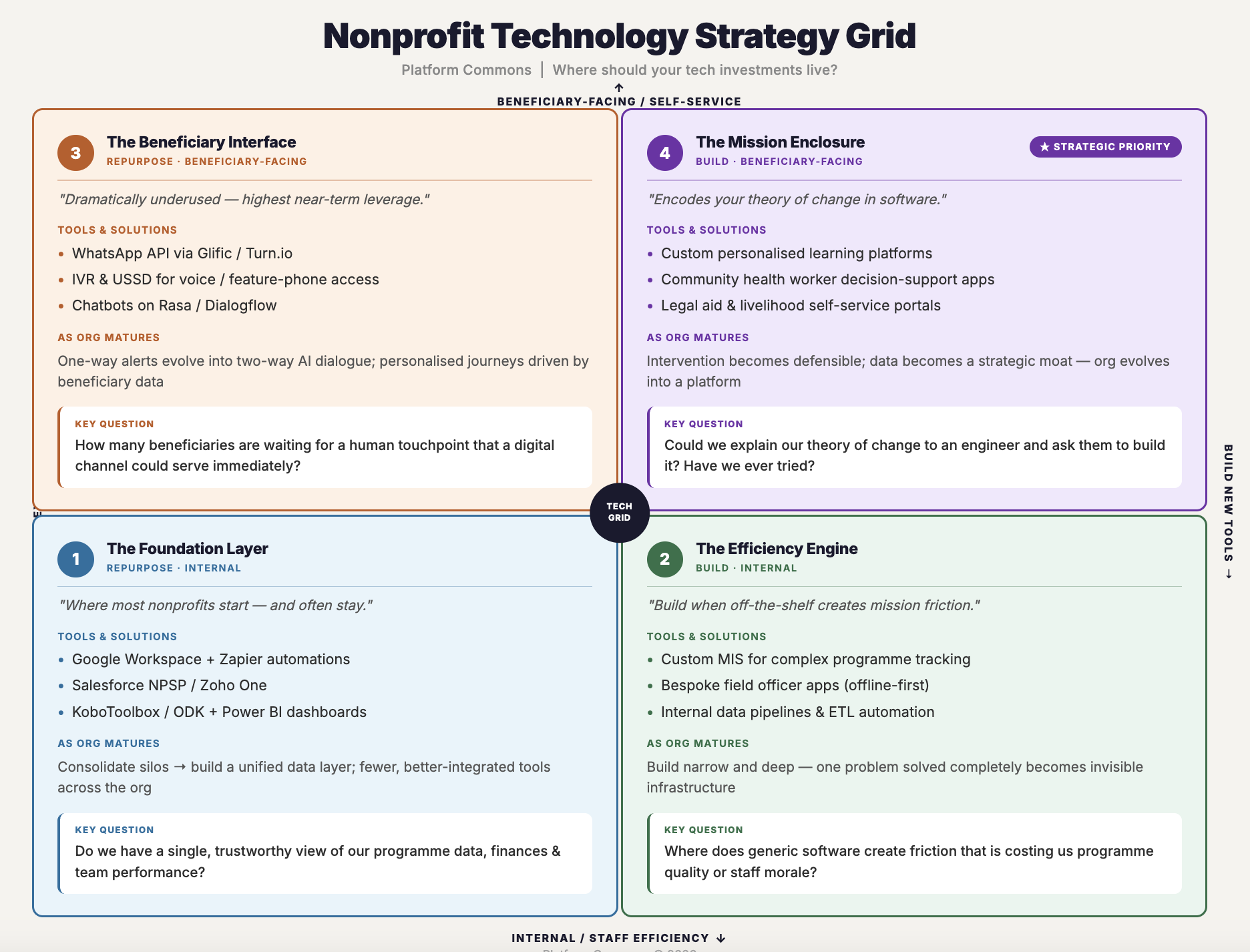
The X-axis runs from Repurpose Existing Tools (left) to Build New Tools (right). This is your build-vs-configure-vs-buy decision axis. On the left, you are working within the constraints and affordances of off-the-shelf solutions — Salesforce, Google Workspace, Kobo Toolbox, Zoho, WhatsApp Business. On the right, you are commissioning custom software: bespoke mobile apps, purpose-built platforms, proprietary algorithms.
The Y-axis runs from Internal / Staff-Facing (bottom) to External / Beneficiary-Facing (top). The bottom is your operations engine: finance, HR, M&E, knowledge management. The top is your mission interface: the surface through which your beneficiaries experience your intervention.
This gives us four quadrants, each with a distinct strategic logic.
Quadrant 1 (Bottom-Left): The Foundation Layer
Repurposed tools for internal efficiency
This is where most nonprofits live. And that’s not a criticism — it is a reasonable starting point. Google Workspace for collaboration. Tally for accounting. Zoho or Salesforce Nonprofit for donor management. Kobo Toolbox for field data collection. Slack or Teams for communication. Notion or Confluence for documentation.
The logic here is sound: why build what someone has already built? The failure mode is over-reliance. Organisations in this quadrant often have 15 disconnected SaaS tools, no integration layer, and data that lives in silos. Staff spend significant time on manual data reconciliation. The tools were each chosen for a specific job but nobody ever designed the system.
As the organisation matures, the imperative in this quadrant is not to add more tools but to integrate and consolidate. The highest-leverage move is building a unified data layer — a single source of truth that pulls from your CRM, your field tools, your finance system, and your HR platform. Tools like Zapier, Make (formerly Integromat), or an in-house data warehouse serve this function.
Examples of tools and solutions:
- Google Workspace + Zapier automations for workflow management
- Salesforce Nonprofit Success Pack (NPSP) for donor and programme management
- Zoho One as an integrated business suite for smaller organisations
- Kobo Toolbox / ODK for field data collection
- Power BI or Metabase for unified dashboards
- Notion for knowledge management
Key question for leadership: Do we have a single, trustworthy view of our programme data, our finances, and our team performance — in one place?
Quadrant 2 (Bottom-Right): The Efficiency Engine
Custom-built tools for internal operations
This is where organisations go when off-the-shelf tools no longer fit the specific complexity of their work. You’ve outgrown generic CRMs. Your field data collection needs are too nuanced for Kobo. Your case management workflow has 14 stages that no product on the market accommodates. So you build.
This quadrant requires the most discipline. Custom builds are expensive, slow, and risky. They are also, when done well, transformative. A custom case management system built for a sexual violence support organisation — with the precise intake protocols, escalation logic, and privacy architecture that their work requires — is not just more efficient. It is safer, more dignified, and more effective than any generic solution.
As the organisation matures, the discipline in this quadrant is to build narrow and deep. The mistake is building broad and shallow — a “platform” that does everything adequately and nothing excellently. The best custom internal tools solve one problem so completely that they become invisible infrastructure.
Examples of tools and solutions:
- Custom MIS (Management Information Systems) for complex programme tracking
- Bespoke field officer mobile apps with offline capability
- Custom payroll and compliance tools for organisations operating across states with variable labour law
- Proprietary logistics and distribution management for last-mile programmes
- Internal data pipelines that clean, transform, and surface programme data automatically
Key question for leadership: Where does generic software create friction that is costing us programme quality or staff morale — and is that friction worth the cost of building around it?
Quadrant 3 (Top-Left): The Beneficiary Interface
Repurposed tools for beneficiary-facing self-service
This quadrant is dramatically underused by the sector — and represents one of the highest-leverage opportunities available to organisations today.
The insight is simple: you do not need to build a custom app to create a powerful beneficiary experience. WhatsApp, IVR systems, USSD menus, SMS, and web forms are already on your beneficiaries’ phones. The art is in designing interventions that flow through these channels with precision, warmth, and measurable impact.
Consider Pratham’s use of IVR for Learning Camps. Or iGot Diksha — the government’s teacher training platform built on existing web infrastructure. Or the countless menstrual health chatbots deployed via WhatsApp in rural communities. These are not technically sophisticated. They are strategically sophisticated — they meet beneficiaries exactly where they are, at zero marginal cost of reach.
As the organisation matures, this quadrant evolves from one-way information delivery to two-way dialogue. Early stage: SMS alerts, IVR hotlines, static web portals. Mature stage: WhatsApp journeys with decision trees, personalised content based on beneficiary data, automated follow-up and progress tracking.
Examples of tools and solutions:
- WhatsApp Business API (via Glific, Turn.io, or direct integration) for two-way beneficiary communication
- IVR systems for voice-based self-service (critical for low-literacy communities)
- USSD for feature-phone-based service delivery
- Chatbots built on Rasa or Dialogflow for guided programme enrolment
- Typeform / KoboCollect for beneficiary self-registration
- YouTube / Diksha for content delivery at scale
Key question for leadership: How many beneficiaries are waiting for a human touchpoint that could be served — immediately, at any hour — through a channel they already use?
Quadrant 4 (Top-Right): The Mission Enclosure
Custom-built tools that encode your unique intervention
This is the quadrant that separates organisations with lasting impact from those with replicable impact.
Every genuinely effective nonprofit has a theory of change that is, at its core, a process. A sequence of interactions, assessments, interventions, and feedback loops that, when executed with fidelity, produce the change you seek. This process lives in the heads of your best programme staff. It is approximated in your training manuals. It is partially captured in your M&E framework.
But it is not, in most organisations, encoded in software.
When you build a custom beneficiary-facing tool — a livelihood assessment app, a personalised learning journey platform, a community health decision-support tool — you are doing something extraordinary. You are translating your theory of change into executable logic. You are making your intervention scalable, consistent, and measurable in ways that are impossible with human delivery alone.
This is the quadrant where organisations stop being service providers and become platform builders. It is the quadrant that Duolingo lives in (language learning as an engineered experience), that Khan Academy lives in (personalised learning at scale), and that, closer to home, iKure lives in (community health delivery via a custom clinical support platform).
As the organisation matures, this quadrant is where your intervention becomes defensible. Not because it is patented, but because it encodes years of learning that cannot be easily replicated. Your data, your journey design, your assessment logic — these become strategic assets.
Examples of tools and solutions:
- Custom learning management systems with personalised pathways (for education NGOs)
- Community health worker decision-support apps (ASHA-facing or beneficiary-facing)
- Livelihood and financial inclusion assessment platforms
- Legal aid self-service portals with guided eligibility checks
- Mental health digital therapeutics built on validated intervention protocols
- Personalised agricultural advisory platforms (as seen in Digital Green)
Key question for leadership: If we had to explain our theory of change to a software engineer and ask them to build it — could we? Have we ever tried?
Part IV: Why Quadrant 4 Is the Strategic Imperative
Organisations are right to start in Quadrant 1. Moving into Quadrant 2 and 3 is natural maturation. But the organisations that will define the next decade of nonprofit impact are those that make serious, sustained investments in Quadrant 4.
Here is why.
First, scale is a distribution problem. Every beneficiary-facing tool you build removes a human bottleneck from your programme delivery. The field officer who used to be the intervention is now the relationship manager. The counsellor who used to give scripted information now handles complex emotional support — because the scripted information is delivered by an app. This is not replacement. It is elevation.
Second, fidelity is a technology problem. The hardest part of scaling any intervention is maintaining the quality of the original. Custom beneficiary-facing tools encode fidelity at the protocol level. The assessment happens the same way every time. The escalation happens automatically. The follow-up is not forgotten.
Third, data is a strategy problem. Custom beneficiary-facing tools generate data that generic tools cannot. Not just “how many beneficiaries did we serve” but “at what point in the journey do beneficiaries disengage? Which content pathways lead to the best outcomes? Which assessment responses are predictive of programme completion?” This is the data that transforms programme strategy from intuition to evidence.
Fourth, your intervention is your moat. In a world where donors are increasingly outcome-focused and funding is increasingly competitive, the organisation that can demonstrate a proprietary approach — not just a well-documented one, but a technologically encoded and continuously improving one — has a profound advantage.
As the Bridgespan Group notes in their analysis of AI opportunities for nonprofits: “The social sector has an opportunity not just to use AI, but to shape how AI is used in service of social good.” That shaping requires ownership of the technical layer. It requires building.
Part V: How AI Is Accelerating All Four Quadrants
AI is not a quadrant. It is an accelerant — and it is currently rewriting the rules of all four.
In Quadrant 1 (Repurposed tools for internal efficiency): AI is collapsing the integration problem. Tools like Zapier’s AI layer, Microsoft Copilot embedded in Office 365, and Salesforce Einstein are bringing intelligence to existing platforms without requiring custom development. Routine administrative tasks — grant reporting drafts, meeting summaries, donor acknowledgment letters, field data quality checks — are being automated at a pace that was unimaginable three years ago. The barrier to entry is low. Every organisation can and should be deploying AI within its existing tool stack today.
In Quadrant 2 (Custom tools for internal operations): AI is making custom builds faster and cheaper. GitHub Copilot and Claude-based coding assistants have materially reduced the cost of building bespoke software. More significantly, AI is enabling organisations to build tools they previously could not afford — a custom document processing pipeline for legal aid organisations, a multilingual field data validation system, a smart dashboard that surfaces anomalies in programme data automatically.
In Quadrant 3 (Repurposed tools for beneficiary-facing self-service): AI is turning static beneficiary channels into dynamic, intelligent conversations. The WhatsApp chatbot of 2022 was a decision tree. The WhatsApp agent of 2026 is a large language model that understands context, handles Hindi-English code-switching, remembers prior interactions, and routes complex queries appropriately. IVR systems are becoming voice AI systems. SMS is becoming conversational. The cost of building sophisticated, beneficiary-facing AI experiences on existing channels has dropped by an order of magnitude.
In Quadrant 4 (Custom tools encoding unique interventions): AI is the most transformative here, and the least exploited. Consider what becomes possible: a personalised learning journey that adapts in real time to a learner’s performance. A community health app that uses computer vision to assess a child’s nutritional status from a photograph. A livelihood programme that recommends the next intervention based on a beneficiary’s social and economic profile and the outcomes of similar beneficiaries. A mental health platform that detects distress signals in typed text and escalates to a human counsellor. None of these are science fiction. All of them are being built, somewhere, today.
The 2025 Techsoup AI Benchmark Report found that 36% of nonprofits now use AI for programme optimisation and impact assessment — evidence that the sector is beginning to move AI from back-office to programme core. The organisations that move boldest here will write the sector’s next chapter.
Part VI: New Models for Assessing Technology Tools
The sector needs better decision-making frameworks. Here are three new models we propose.
Model 1: The Leverage Ratio Framework
Before adopting or building any technology, ask three questions:
Scale multiplier: How many more beneficiaries, donors, or staff actions does this tool enable per unit of cost?
Fidelity coefficient: Does this tool improve, maintain, or degrade the quality of our programme delivery?
Data dividend: What new data does this tool generate, and what decisions does that data make possible?
A tool with a high scale multiplier, high fidelity coefficient, and rich data dividend is a high-leverage investment. A tool that is cheap but scores low on all three is a low-leverage distraction, regardless of its price.
Model 2: The Intervention Encoding Score (IES)
This model helps assess how well a technology tool actually captures your unique theory of change. Score your tools (existing or proposed) from 1–5 on each dimension:
| Dimension | Description |
|---|---|
| Protocol Fidelity | Does the tool enforce your intervention protocol, or leave it to human discretion? |
| Beneficiary Agency | Does the tool increase a beneficiary’s ability to self-serve, self-advocate, or self-track? |
| Feedback Loop Quality | Does the tool generate data that can improve the intervention over time? |
| Channel Fit | Is the tool delivered through a channel that is genuinely accessible to your beneficiary population? |
| Iteration Velocity | How quickly can the tool be updated as your theory of change evolves? |
Tools scoring 20–25 are strategic assets. Tools scoring below 10 should be reconsidered. The IES is particularly powerful when applied to Quadrant 4 investments — it forces a rigorous articulation of what your intervention actually is.
Model 3: The Technology Maturity Ladder
Organisations tend to progress through five stages of technology maturity. Knowing where you are is the first step to moving deliberately.
Stage 1 — Reactive: Technology adopted in response to immediate pain points. No coherent strategy. High tool proliferation, low integration. Data lives in silos.
Stage 2 — Operational: Core tools standardised across the organisation. Basic integrations in place. Leadership has visibility into programme and finance data through dashboards.
Stage 3 — Strategic: Technology investments tied explicitly to programme outcomes. A dedicated technology function (not just IT support) exists. Annual technology roadmap is reviewed at the board level.
Stage 4 — Innovative: Organisation has built at least one custom tool that encodes a proprietary intervention. Data from technology tools actively shapes programme strategy. AI is deployed in at least two quadrants.
Stage 5 — Platform: Organisation’s technology stack is a platform — other organisations adopt, partner with, or build on it. Technology is a competitive moat and a scaling vehicle. Data is a strategic asset.
Most large Indian nonprofits are at Stage 2 or early Stage 3. The aspiration should be Stage 4 within three years, and Stage 5 for organisations with genuine scale ambitions.
Part VII: The Technology Strategy Canvas
A working tool for your leadership team
Below is a canvas designed to be filled by your technology, programme, and strategy leads together. We recommend a half-day offsite to work through it. The value is not in the answers — it is in the conversation the questions force.
Part VIII: What Separates the Best From the Rest
We have had the privilege of working with some of India’s most ambitious nonprofit organisations. The ones that consistently punch above their weight on technology share a handful of habits that are worth naming.
They have a product mindset, not a procurement mindset. They think about technology in terms of user experience and outcomes, not features and prices. Their CTO (or equivalent) sits at the programme strategy table, not just the IT support desk.
They invest in the layer below the tools. Data infrastructure, integration, and architecture are unglamorous. They are also, almost always, the thing that determines whether individual tools deliver value or sit idle. The best organisations treat data infrastructure as strategic investment, not IT overhead.
They build for beneficiaries first. When budget is scarce — and it always is — the highest-leverage choice is the one that directly improves the beneficiary experience. Not another internal dashboard. Not a fancier website. A tool that puts a capability directly in the hands of the people they exist to serve.
They iterate. Commercial products go through hundreds of iterations. The best nonprofits apply the same discipline — they ship, they measure, they learn, they ship again. Technology is not a project. It is a practice.
They talk about technology at the board level. Not just cybersecurity and compliance. Strategy. Where is our technology relative to our programme ambition? Where are we under-invested? What are we building in the next three years and why? According to BizTech Magazine’s 2026 Nonprofit Tech Trends report, organisations that include technology on their board agenda systematically outperform those that relegate it to the CTO’s quarterly update.
A Word on Trust and Equity
No article on nonprofit technology is complete without a reckoning with equity.
Technology can serve as a lever for justice — or it can replicate and amplify the inequities already embedded in our systems. A beneficiary-facing tool built without beneficiary input is, at best, paternalistic. At worst, it is harmful. A data system that collects community information without a clear consent framework is not innovation — it is extraction.
NTEN’s 2025 Equity Guide for Nonprofit Technology is unequivocal: “Nonprofit technology is marked by inequities within organisations and the sector… these inequities must be dismantled if organisations want to address communities’ needs permanently.”
The canvas above, used well, forces these questions. Whose voices shaped our intervention design? Who was in the room when we chose our beneficiary channel? Who has access to the data we collect, and for what purposes?
The organisations that will build truly transformative technology are the ones that hold both ambition and accountability — who see technology not as a gift they give to communities, but as a capability they build with them.
The Leverage Mindset
We started with a boardroom. Let us end there.
The next time your leadership team reviews the technology budget, we invite you to run a simple experiment. Instead of asking “can we reduce this?” ask: “Given our programme ambition for the next five years, is this enough?”
The sector’s most pressing problems — learning poverty, climate vulnerability, gender-based violence, broken health systems — are not going to yield to incremental approaches. They require interventions at scale, delivered with fidelity, continuously improving based on evidence. That description, almost word for word, is a description of a well-engineered product.
You are already a tech company. The only question is whether you are building the technology your mission deserves.
Let’s Talk
At Platform Commons, we work with nonprofit leaders to audit their technology landscape strategically — not to sell tools, but to build clarity. We help organisations understand where they are on the maturity ladder, where their highest-leverage investments lie, and what it would take to move from operator to platform builder.
If this article has prompted questions you don’t yet have answers to — about your quadrant distribution, your intervention encoding, your AI readiness, or your technology maturity — we’d love to have that conversation.
Request a Strategic Technology Audit →
No pitch decks. No cookie-cutter recommendations. Just a rigorous, honest audit of where your technology is and where it could take you.
Sources & Further Reading
- Strategic Technology Planning for Nonprofits: Priorities and Considerations for 2026 — Grassi Advisors
- Tech Trends 2026: What to Anticipate in the Nonprofit Sector — BizTech Magazine
- Study: Nonprofits Must Embrace Digital Transformation in 2025 — NonProfit PRO
- 2025 Nonprofit Tech: What Worked, What Didn’t, and What’s Next — Roundtable Technology
- Equity Guide for Nonprofit Technology — NTEN, 2025
- AI Can’t Be Ignored: Exploring the Opportunities for Nonprofits and the Social Sector — Bridgespan Group
- Benchmark Report: The State of AI in Nonprofits 2025 — TechSoup
- Nonprofit Technology Trends 2026: What Leaders Need to Know Beyond the Hype — OpenGrants
- How Mission-Driven Nonprofits Leverage AI to Achieve Social Good — BizTech Magazine
- Why Technology Is the Key to Nonprofit Impact, Capability and Growth — Protiviti
© Platform Commons 2026. This article may be shared freely with attribution.